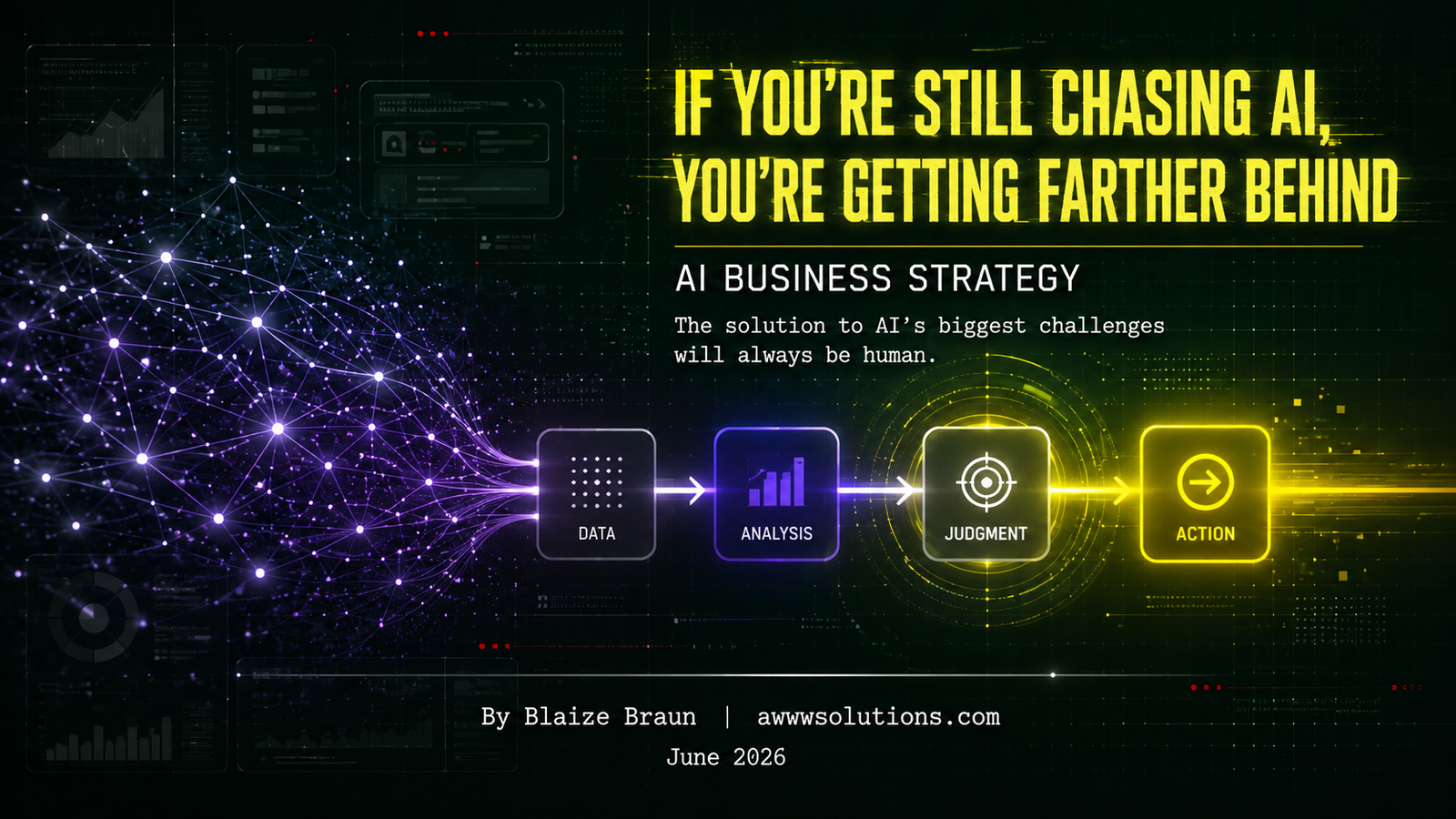
If You’re Still Chasing AI, You’re Getting Farther Behind
The industry spent hundreds of billions proving a point everyone believed is the next big thing. The answer was human all along.
$700B +
Projected Big Tech AI spend in 2026 alone
− $$$
Artificial Innovation, at what cost?
$0
ROI from AI most businesses can prove
Remember when everyone and their LinkedIn post, every conference keynote, every breathless conversation declared the same thing?
“If you’re not already in AI, you’re already behind.”
That message was everywhere. Urgent, loud, and almost entirely unchallenged. And a lot of businesses believed it. They pivoted. They replaced people. They restructured entire departments around tools that were still — and frankly, still are — figuring themselves out.
Here we are in 2026. And the numbers don’t lie, but they do tell a different story than the hype did…
The Arms Race Nobody Asked You to Join
Big Tech is on track to spend over $700 billion on AI infrastructure this year alone, a more than 60% jump from already-historic 2025 levels. Amazon. Alphabet. Microsoft. Meta. These are companies with some of the strongest balance sheets in the history of capitalism, and they are burning cash at rates that would collapse almost any others.
That matters to you ~ not because you should follow their lead, but because you *shouldn’t*.
The arms race being run by trillion-dollar companies with hundreds of billions in reserves is not a playbook for the rest of us. It is a warning. When the largest, best-capitalized businesses in the world cannot yet demonstrate proportionate returns on AI investment, what does that mean for a small or mid-sized business that restructured around it?
It means the cost isn’t just financial. It’s strategic. It’s human. And it compounds.
The Real Problem With “Don’t Get Left Behind”
Fear is one of the most effective marketing tools ever invented. And the AI conversation leaned into it hard.
The message was essentially: adopt AI or become irrelevant. Replace workers with automation or lose to someone who did. Move fast, or get moved past.
But here’s what that framing missed entirely, and why it matters more now than it did before:
AI doesn’t create problems and then solve them. We do.
Every hallucination. Every bias baked into an output. Every flawed decision made by an unmonitored system. Every job eliminated in the name of efficiency that quietly gutted the institutional knowledge a company took a decade to build. Those are human decisions with human consequences.
You cannot automate your way out of problems you automated yourself into.
At the scale we are now watching in real time, those decisions don’t just affect individual businesses… They affect entire economies. Our economy. The wealth concentration and division happening right now in AI infrastructure is not incidental. It is structural. We are watching capital consolidate at a speed and scale that mirrors some of the most destabilizing economic moments in modern history.
The businesses that can’t absorb the cost of chasing AI as a strategy aren’t going to pivot gracefully. Many of them are going to lose. Not to a competitor who out-innovated them… to a sunk cost of the next big thing we are told is a necessity.
*De-Idolizing the Tool*
Here is what actually needs to happen (and what the quieter, more sustainable businesses are already doing) in my opinion…
AI needs to be de-idolized as a business solution;
and destigmatized as a productivity tool.
AI is a tool just like sharpened stones, the wheel, and airplanes. For example ~
AI as a hammer is extraordinary. AI as an architect is a liability. The businesses getting this right are using AI to do what tools are supposed to do: innovate, simplify, increase productivity, and free up the people doing the work by doing it better. They are not (hopefully) using AI as a substitute for human judgment, quality assurance, or revenue touching. They are not measuring success by blind AI adoption. They are asking a different question entirely:
What does this tool make capable AND can it do better than I?
Human-first isn’t anti-technology. It is pro-humanitarian.
It means asking the right questions before writing the prompt. It means understanding that human relationships, creativity, ethical accountability, and contextual judgment are inimitable. At our core we, and all that we create in the world is strengthened through investment in people. This means recognizing that the value of your business is not what your AI stack can replace. It’s what your people can do with it.
What This Means for Your Business Right Now
If your competitors are still treating AI adoption as a strategy rather than a capability, they are running toward a moving target with a diminishing return. That is not a race worth joining at their speed.
The most durable brand you can build in 2026 is not “we rely on AI.”
It’s leveraging innovation so you can think clearly, show up fully, and lead ethically.
The solution to the problems AI is creating will always be human. Because we are the ones creating them.
At this point I only wonder whether enough businesses figure that out before the cost of not knowing becomes irreversible, if not already.
REMEMBER: We create the market.
AWWW Business Solutions helps businesses build human-centered strategies that leverage technology — without costing you more than your investment.